
Charging Into the Unknown


You’ve felt this before: that spark of anxiety when your phone or laptop battery drops to 5 percent, and you’re rushing to finish a message or book a ticket, with no real idea whether you have 30 seconds left or ten minutes. That’s because the number on your screen is not as trustworthy as it looks. Your phone might say there’s 20 percent battery one moment and be dead ten minutes later, or it could freeze at 1 percent for what feels like an hour, refusing to die.
This isn’t your imagination. It’s a fundamental limitation of how we estimate the state of charge of batteries.
There really is no direct way to measure how full a battery actually is. Its remaining ”juice”, or state of charge, can only be estimated indirectly, using measurements such as voltage and current that are fed through models that approximate the real number. For lithium iron phosphate (LFP) batteries (increasingly the standard for large-scale energy storage), these estimates can be off by as much as 20 percent. For your phone, that’s an annoyance. For a utility-scale battery plugged into the electricity grid, it can be very expensive.
When a guess becomes a broken promise
Large-scale batteries connected to the electricity grid don’t just simply store energy. They participate in electricity markets, where power is bought and sold the same way people buy and sell potatoes or wheat on a commodity market. They promise to deliver or absorb a certain amount of power at a certain time. On top of that, they promise to be ready, within seconds, to help keep the grid’s supply and demand in balance, a service called frequency reserves.
Both of those promises depend on the battery operator knowing how much charge is actually available. If the real state of charge is different from what the operator thinks it is, say 15 percent off, those promises can’t be kept. For a battery trading in electricity markets, that means financial penalties for failing to deliver as promised. Worse, in an emergency, it can mean the battery simply doesn’t have enough energy to back up the grid when it’s most needed.
Two different communities are dealing with this problem, each from their own side. Battery chemists and data scientists attack it at the source, using better sensors, better internal models of how the battery behaves, more data, and smarter estimation algorithms. This work matters and the results keep improving, but even the best estimators still carry real, unavoidable error. The chemistry of an LFP battery just doesn’t give up its internal state easily.
Battery operators, meanwhile, treat the uncertain number as a given and defend against it. If you can’t fully trust your charge estimate, you build in a safety margin. You never bid on the market as if you have 100 percent of the battery’s stated capacity. Instead, you hold some back, just in case. This works, but it’s a blunt instrument. A margin that’s too thin risks failing your promises. A margin that’s too thick means leaving usable capacity, and revenue, on the table, all day, every day.
Bringing the two worlds together
As part of a research group at ETH Zurich and NCCR Automation, we've been investigating exactly this problem, starting from the key point that bridges the two perspectives: the size of the estimation error isn’t fixed. It depends on how the battery is being used. Error tends to build up gradually during everyday, midrange operation, which is exactly where a battery spends most of its time when providing grid reserves. But it clears when the battery is driven close to fully charged or fully discharged: then the reported number and the true number come back into alignment.
In other words, the operator’s decisions and the chemist’s estimation problem aren’t separate at all. How you run the battery directly affects how much you can trust what it’s telling you.
Working closely with people who actually trade batteries in electricity markets, we developed a bidding strategy that puts this connection to direct use. In these markets, bids are typically calculated by an algorithm automatically, not adjusted by a trader by hand hour by hour. What we added to that algorithm is uncertainty awareness: instead of relying on a fixed (and high) safety margin, we made that algorithm aware that its own decisions affect how uncertain its estimate will be later on. It weighs the immediate profit of a decision against the benefit of occasionally pushing the battery toward full or empty to sharpen the estimate, which lets it reduce the safety margin.
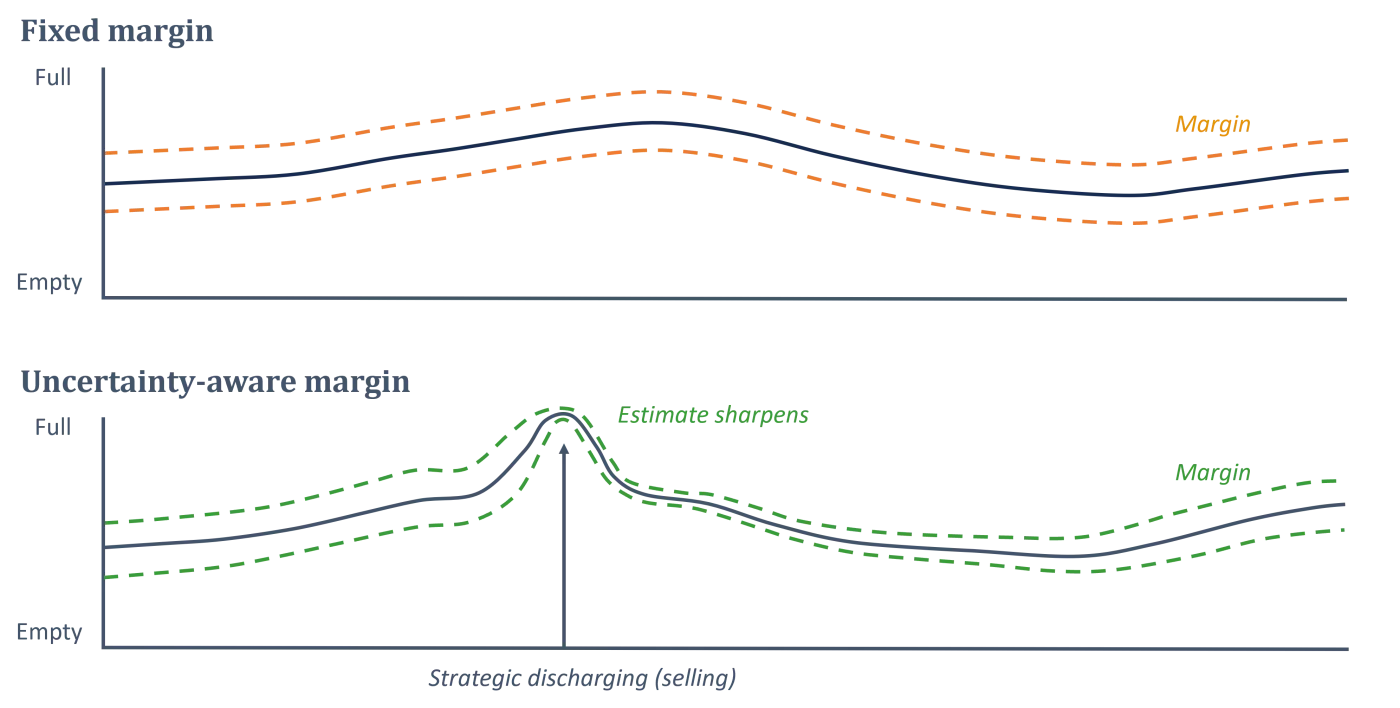
Compared with fixed safety margins, this uncertainty-aware approach keeps the battery just as reliable, while earning meaningfully more. In our six-month simulation, at a similarly high level of reliability in reserve provision, the uncertainty-aware strategy earned around a third more revenue than a fixed safety margin. The difference comes down to how the caution is spent. A fixed margin spends it everywhere, all the time. Ours spends it only where it's actually needed, and removes it everywhere else.
The next time your phone battery does something inexplicable, it’s worth remembering: somewhere, a much bigger battery is having the exact same identity crisis. The difference is, with our approach, this one can be operated smartly enough to know when to trust its own guess, and when to act to guess better.