Via Automation - a small tour of automatic control

In December was the annual ‘Nobel weekʼ in Stockholm; a week to commemorate and celebrate science (1). As part of the Nobel celebrations, there were lectures by laureates on topics ranging from the immune system to quantum mechanics. As part of this week and to extend the celebrations, the city also hosted a large light festival, displaying some state-of-the-art lasers, optics and projection mapping techniques (2). See for instance the picture below, as taken in the city centre.
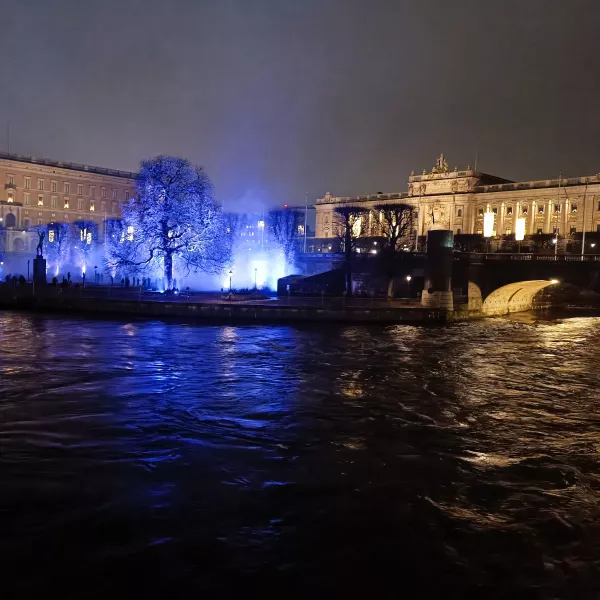
Now, when we speak of science and technology in general, the topics presented by the laureates are indeed the subjects that might spring to mind first, but maybe not for somone trained in automatic control. Let us revisit the picture above and detail this conundrum.
On the right of the blueish light spectacle we see the Norrström, a very short river; which is interesting for the following reason. Stockholm is surrounded by vast amounts of water, in particular, with lake Mälaren to the west, and the Baltic sea on the east. The lake is the main source of fresh water, yet, after periods of heavy rain or melting snow, there are occasions where some excess water needs to be released. In principle, this can be done through the connection—via Stockholm—to the ocean. However, the lake is just under 70cm above sea level, which means that under specific weather conditions, salt water could flow back into the lake, with all sorts of consequences we would like to avoid. As fully enclosing the lake is not an option, a regulation system was put into place in 1943. Here, the regulation is in particular enabled by means of water locks, where the control strategy of these locks is based on data and ever improving meteorological and hydrological mathematical models (3).
Even more so, one can find the following ‘block diagramʼ in a report by the Swedish Meteorological and Hydrological Institute (SMHI):
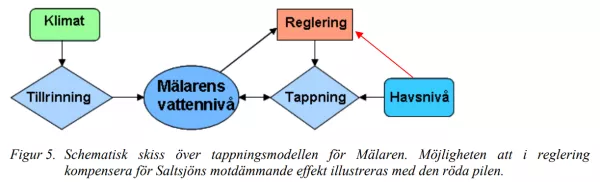
In the block diagram above, one observes a controller (Reglering) that interacts with the water level of both the lake (Mälarens vattennivå) and the ocean (Havsnivå). Indeed, the Norrström river is part of this ‘closed-loop systemʼ, connecting the lake to the ocean. These type of block diagrams are at the core of the field of control theory, and we will see them again in future posts when we say more about ‘feedbackʼ (4).
Finally, we should mention that this regulation system is concentrated at Slussen and has been evolving ever since Queen Kristinaʼs first water lock, installed as early as 1642. The newest version of the lock is designed to robustly accomodate climate change (5), which is fascinating from an automatic control viewpoint.
As interesting as this water regulating system is, if everything goes well—as it does—most of us will not notice the presence of such a critically important control system. This happens to be a common feature of control systems, as was particularly clearly seen not far from here in Stockholm.
Namely, Karl Johan Åström—a professor in Lund and one of the leading figures in our field—described automatic control as a hidden technology in his 1999 overview article (6). This description became very popular afterwards, with good reason. For instance, automatic control applies to virtually any field of science and engineering, and is largely an enabler, yet, it is rarely the end goal itself.
Perhaps the best reason, as re-emphasised by Robert Bitmead—another influential figure in our field—can be stated as (7) “The more perfectly a control system works, the less you notice it.ˮ
This is what we tried to illustrate above and this exact problem should be contrasted with visually impressive robotics demonstrations and the like; lots of control systems go unnoticed, by design.
Now, within the NCCR Automation and similar research consortia, we work on advancing the field. To put these developments in the right context it is important to see what we already have, however, this might be complicated—especially for the newcomer—as some of it is indeed ‘hiddenʼ. Thus, to further welcome any newcomers and showcase our beloved field, we aim to elucidate several quintessential automatic control topics in a short series of posts and show that the field is indeed omnipresent and far from mysterious.
Last winter, I walked around in Stockholm, but in the upcoming weeks I will take you on a small hike through Switzerland. We will explore the Via Automation, discussing cows, gondolas, coffee and more.
(1) https://www.nobelprize.org/ceremonies/nobel-week-2025/
(2) https://www.nobelprizemuseum.se/en/nobel-week-lights/The first picture of this article displays ‘Divine Geometryʼ, see:
https://www.nobelprizemuseum.se/en/nobel-week-lights/festival-2025/divine-geometry /
(3) https://miljobarometern.stockholm.se/content/docs/tema/klimat/Malaren/SMHI Forslag-ny -reglering-Malaren-rapport-2011.pdf
See page 13 for more on their control strategies.
(4) If you cannot wait, listen to: https://www.incontrolpodcast.com/1632769/episodes/18193180-ep38-incontrol-guide-to-feedback
(6) https://link.springer.com/content/pdf/10.1007/9781447108535_1.pdf
On page 1: “Automatic control systems are today pervasive. They appear practically everywhere in our homes, in industry, in communications systems, in all types of vehicles and in scientific instruments. Control systems are increasingly becoming mission critical, a failure of the control system will thus lead to a system failure. In spite of this automatic control is not very much talked about. It is therefore appropriate to label the technology the hidden technology.ˮ