
Via Automation - a tour of automatic control: Fixed points and coffee
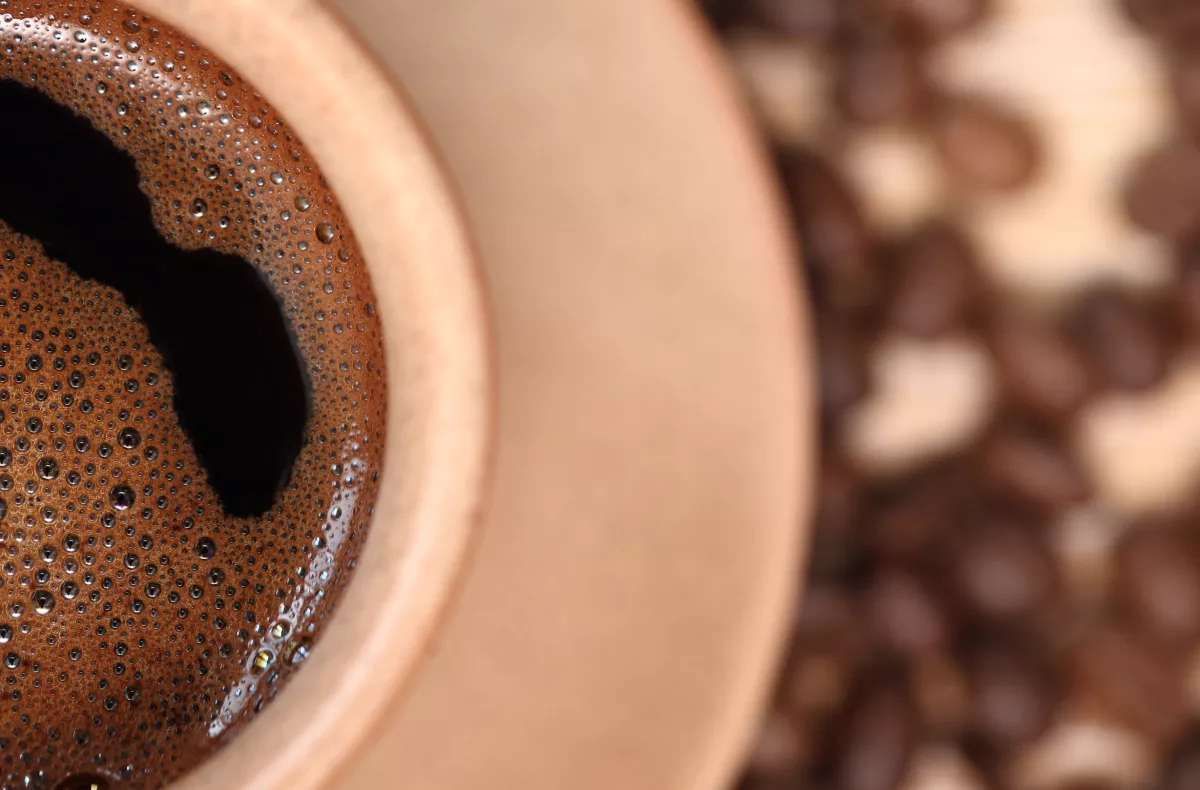

Now, if you look at a freshly brewed coffee you will see the most beautiful moving patterns and swirls. This is a mesmerising dynamical system, just in front of your eyes. A dynamical system displaying all sorts of fundamental physical phenomena [1]. A dynamical system closely related to one of the main open problems in mathematical physics, namely, understanding solutions to the infamous Navier-Stokes equations.
The Navier-Stokes equations describe the flow of fluid, just as Newtonʼs more famous (second) law describes the motion of a mass. However, the Navier-Stokes equations are significantly more difficult to handle as we need to work with considerably more variables, e.g densities. What these equations have in common is that they are differential equations,meaning that they describe instantaneous change. So, when dropping a ball, Newtonʼs equations describe the forces acting on the ball, but if you want to obtain the actual trajectory of the falling ball, you need to ‘solveʼ the differential equations. You need to find a ‘solutionʼ to the differential equations, given some initial condition. This is clearly much harder for a fluid than for a rigid ball.
In case of the Navier-Stokes equations, this is precisely where some open problems prevail. We can write down the differential equations, but is there always a solution? You can imagine this has ramifications for our understanding of physics. Beyond predicting the motion of coffee, think of all the problems in climate science that relate to fluids (ocean currents and trade winds, to name just two examples). Rigorously understanding the dynamics is of great importance there. Perhaps surprisingly, the 3D version of this problem (that is, understanding all solutions to the 3D Navier-Stokes equations) is still an open question in science [2], while the 2D version is well-understood [3]. There we know enough to have well-behaved solutions.
Indeed, we can interpret the surface of your coffee as a 2D fluid. This - bubbles aside - means that mathematics tells us that these patterns we see in our coffee, are evolving continuously. Clearly, this agrees with experience.
Interestingly, exactly this observation reveals that your coffee shows more than physics. In fact, you can do a simple experiment that captures yet another highly influential technical concept. This time, a mathematical concept. If you take two pictures of the swirling surface of your coffee and compare them, at least one point did not move. Always. In this case, we physically observe a fixed point, a mathematical notion of great importance, also for automatic control. Mathematically, if we have a map (a function) f, then x is a fixed point when f(x)=x.
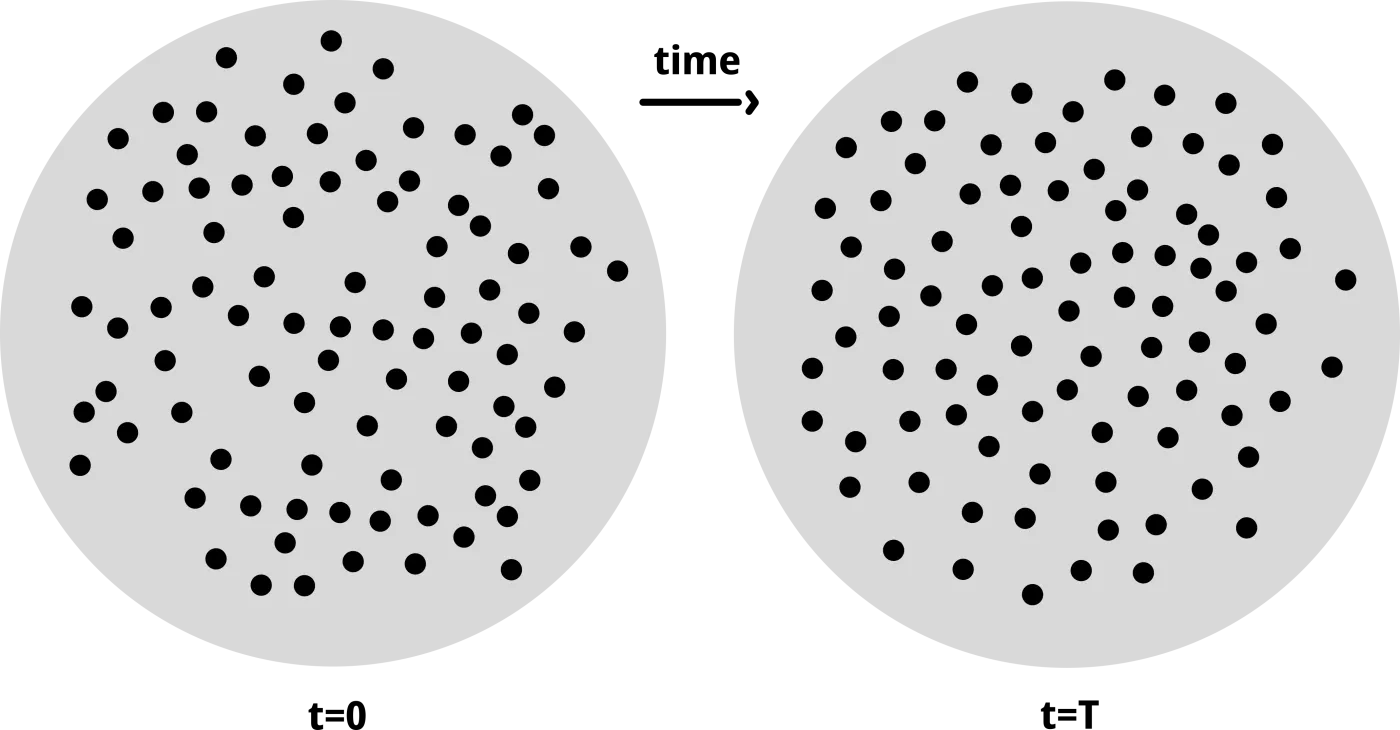
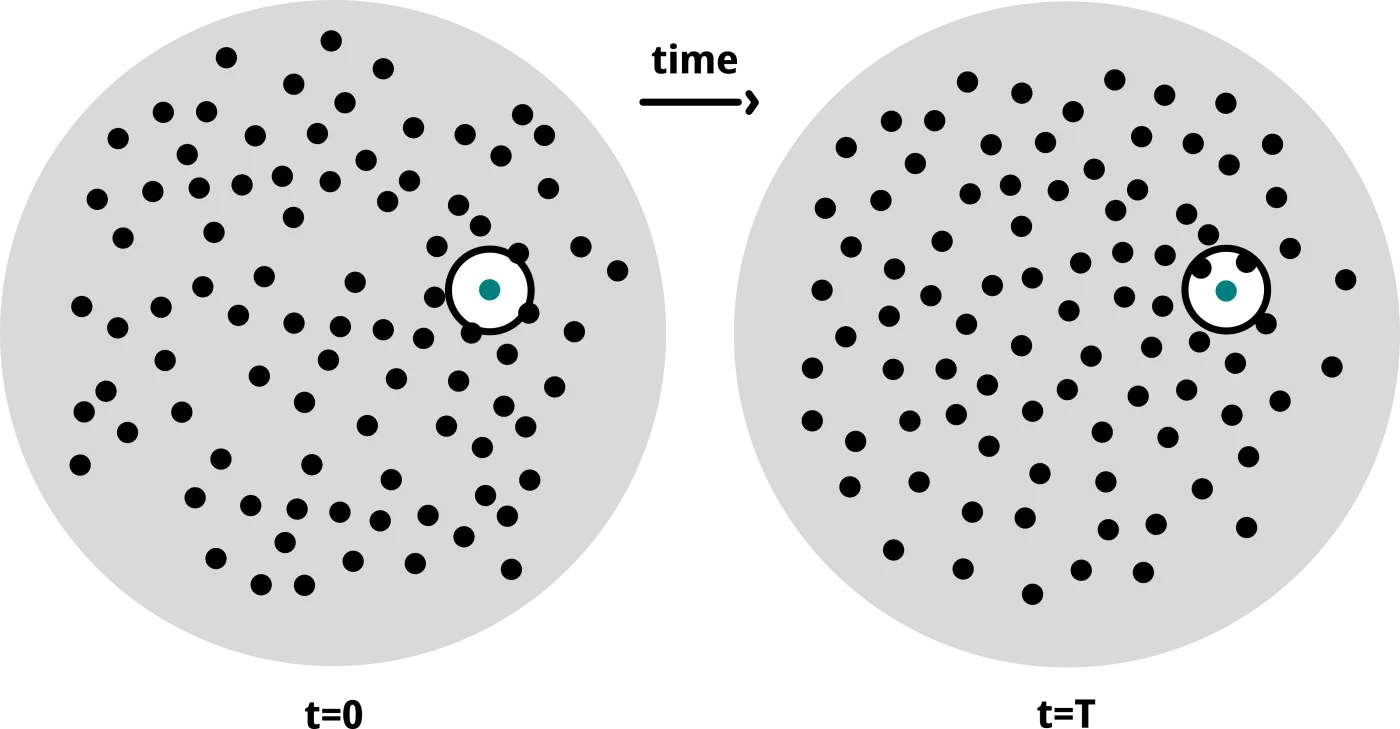
To elaborate, when we think of time progression as a map, then the above displays a map from the disk to itself (from time=0 to time=T). However, since those points move along with the coffee, this is not any map, but a continuous map, as argued above. This means we can appeal to Brouwerʼs fixed point theorem, stating that a continuous map from the disk to itself must have a fixed point [4].
Understanding the existence of fixed points is of utmost importance in all mathematics. For us, fixed points typically help in capturing optimality or some form of stability.
To provide some intuition regarding the last claim, consider having access to a magic oracle that tells you where to move to find a pool of water. Suppose that this oracle only provides updates of at most 1 meter. First you might be told to go 1 meter to the left, then straight ahead, again to the left and so forth. At some point the oracle tells you that you should move 0 meters. Stay where you are! Differently put, the oracle maps your current position to itself. You are at a fixed point! And in the water.
We elaborate on using fixed points in the next post when we plan our way to the top.

References:
- A rather extensive overview of ‘Culinary fluid mechanics and other currents in food science' can be found here: https://journals.aps.org/rmp/abstract/10.1103/RevModPhys.95.025004.
- You can win a very big prize by solving this problem: https://en.wikipedia.org/wiki/Millennium_Prize_Problems#Navier–Stokes_existence_and_smoothness. See also https://www.claymath.org/wp-content/uploads/2022/06/navierstokes.pdf
- See this excellent and recent overview by Vladimir Šverak https://www.youtube.com/watch?v=BaDxv5Z4LkU
- See this text by Hirsch for an elegant proof https://link.springer.com/book/10.1007/978-1-4684-9449-5. Regarding Brouwer himself, the recent book ‘The Great Math War: How Three Brilliant Minds Fought for the Foundations of Mathematicsʼ by Jason Socrates Bardi contains a very intruiging historical perspective.